It was a Friday morning, which meant that the kids and I were gathered in the living room for our weekly “Friday History” day. I sat criss-cross on the floor, Nico in my lap and our History textbook perched in front of me while the others sprawled on couches and dangled over the sides of chairs as the Tuttle Twins regaled us with stories about Marco Polo and his adventures along the Silk Road. I hoped they were listening, but I couldn’t be sure. But then Charleston stopped me mid-sentence so that he could run for some visual aids. He returned with a globe, a laminated world map, and some whiteboard markers, then proceeded to translate the lesson for Kali and Sully, adding in his own insights and colorful commentary. I’d hoped they were engaged with the lesson as I was reading; now, seeing Charleston teach and watching the twins ask questions and give commentary of their own, there was no doubt that true learning was taking place. I had been sidelined as teacher and moved into a facilitator role, and I couldn’t be happier.
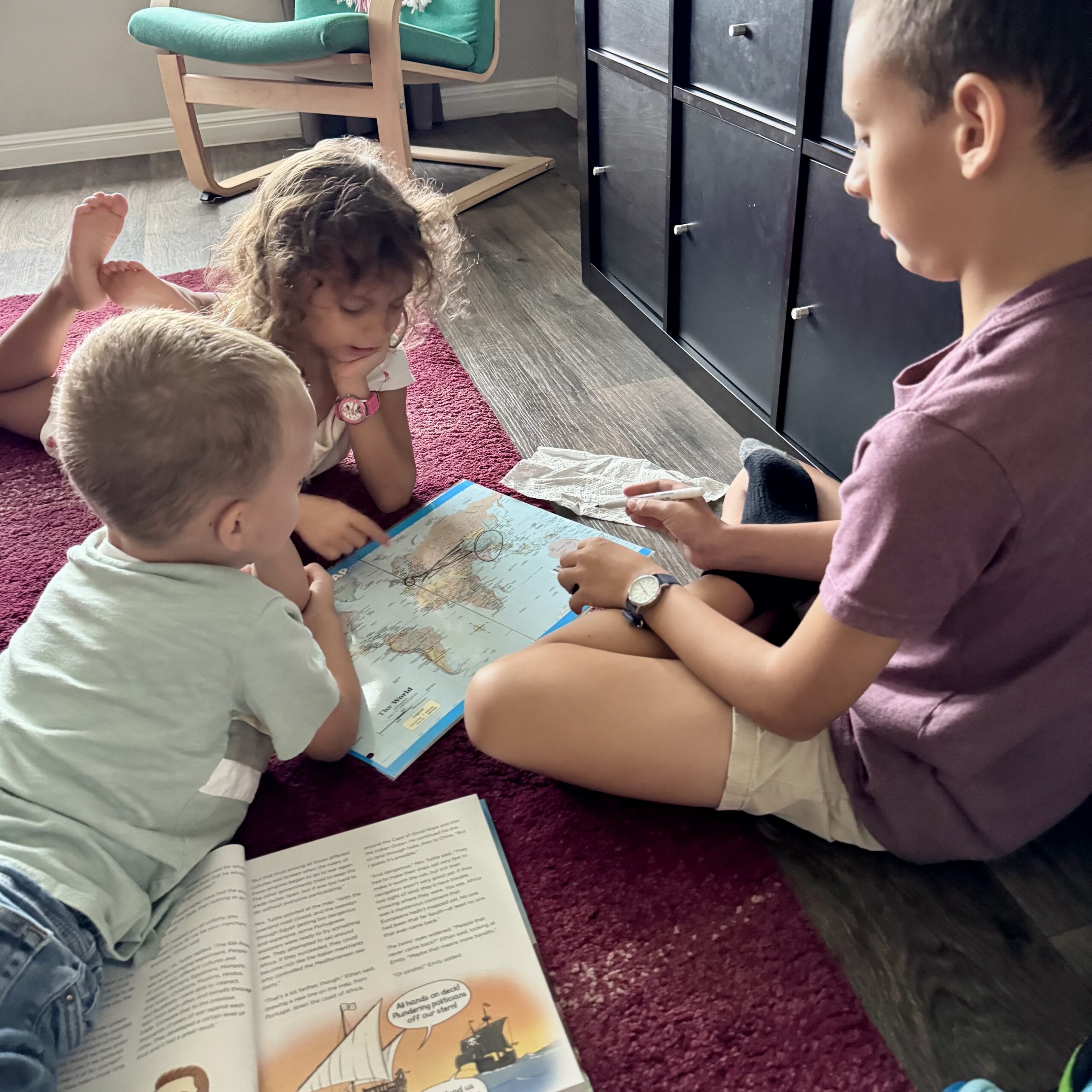
I’ve written before about the benefits of homeschooling in a multi-age setting, and we continue to reap those benefits in our home. I love teaching my kids, but what I REALLY love is when the kids latch onto what they’ve learned and are able to turn around and teach it to their siblings. Kalinda, Sullivan, and Nickelson (and sometimes Charleston) are far more receptive to insights and lessons from each other than the ones I can offer them, and I see how much additional learning takes place in the minds of the siblings who are doing the teaching. Sully might grasp the idea of a clock, but I know he gets it when he can turn around and explain the minutes and hours to his sister. Kali’s greatest strides in reading have been when she’s explaining letters to Nico. Even Nico gets on board with the teaching role as he introduces new “tricks” to Arlo.
The benefits of being a teacher apply to me, too: as an elementary school teacher and tutor, and now a teacher to my kids, I’ve cultivated a far deeper understanding of the material I’ve been responsible to teach than I had of that same material as a student. Age and maturity factor into this, of course, but it’s largely the act of teaching something to someone else that helps to solidify those ideas and concepts in my own mind. I am positive I never truly understood the concept of place value until I was a student teacher explaining numbers to my class of first graders, and I remember the novels I taught my pupils with greater clarity and insight than the ones I read for myself as a student.
My public school teaching days are a distant memory, but I experience the phenomenon to this day: just this past winter, I taught a large-group lesson on the Divided Kingdom to the 4th- and 5th-graders at church. The following month had me reading those passages in my own Bible reading plan, and I realized that teaching the time period earlier in the year had given me an appreciation and genuine understanding for a part of the Bible that never fully made sense in all of my previous read-throughs of the Bible. Time and again, I’ve seen that TEACHING is absolutely the best teacher. As someone who loves learning (“Learner” is one of my top strengths), it’s no wonder that homeschooling my kids has brought me so much joy and fulfillment.
A while back, I heard a podcast in which two Bible teachers talked about how being “on the hook” for writing weekly sermons made them much more attentive to the ins and outs of daily life. Every moment and interaction had the potential to be repurposed for a sermon illustration. Reading books or listening to podcasts were no longer passive activities, but research for Sunday’s teaching. Seemingly mundane activities or conversations could be filed away for future talks. These two pastors expressed gratitude for the role that required them to be more attentive to their own lives and God’s unique ways of showing up. Their jobs meant that they needed to pay attention in ways that benefitted them as pastors, but also as humans and followers of Christ—because not EVERY moment could fit into a teaching or sermon, but noticing those moments WOULD give intentionality and meaning to their own lives. The pastors observed that their congregants would benefit from some mandatory time in the pulpit each week, because it would help them start noticing and applying what they were learning.
I continue to write for this very reason. I’ve been mining my own life for blog content for nearly thirteen years now, and being a curator of this space has made me much more attuned to my own life. I am a better observer and absorber of my settings, my family, the content I consume, and my own feelings because I know I’ll be translating those experiences and observations into stories and words I share here. I pray that my words have encouraged, inspired, or challenged my readers, but even if nothing I wrote was ever read by another human being, I am confident that the sheer act of writing has transformed me. I am a better wife and mom, a more faithful follower of Christ, and a more engaging dinner party guest because I write. Composing these musings is just a small part of how I spend my time each week, but the impact on the remaining time is immeasurable.
In the Classical Conversations world, we talk about five core learning tools that we utilize to help our students understand the foundational knowledge of every subject: Naming, Attending, Memorizing, Expressing, and Storytelling. While each of these habits is critical for genuine learning, I would argue that Attending is the habit on which every other habit rests. Attending—noticing, observing, paying attention—is the building block for all knowledge acquisition and further application. We can’t truly know—let alone understand and apply—something if we haven’t first observed it. Since leaning more into the Classical model of teaching, I now begin every lesson by asking my kids to attend to the content: before I begin introducing or discussing something new, I invite them to pause and notice what they see on the page. This opens their minds to the lesson ahead and paves the way for new knowledge to settle in.

Attending isn’t strictly a habit for Classical learning, or for children. All of us would benefit from applying greater attention to our lives—pausing to notice what we are seeing, sitting with situations and conversations and interactions around us, recognizing the nuances of our own internal monologues. Attending keeps us from walking blindly through life and opens us up to how God is working in, around, and through us. I think this is why writing and teaching are so beneficial for me: these roles are the encouragement I need to attend to life rather than stumble my way through it. I’m sure it would be possible to be an attentive individual without these external motivators; for me, the roles of teaching and writing lend extra motivation to sit up and pay attention!
I am curious about your thoughts on this: are you someone who intentionally attends to your life? Do you have any external motivators that encourage you to be a thoughtful observer and attender to life? How might you cultivate these skills in yourself, or your children? I’ve shared that writing and teaching are what help ME with this, but I would LOVE to hear from you if you have other strategies for adopting a deeper practice of attention!